July 23, 2014

Storm Cleanup

The storm that moved through Grand Forks on Monday evening brought wind gusts of close to 70mph and somewhere in the area of 2-3".  This was by far the most intense storm I have witnessed in my three years here so far.  However, after a brief survey of the damage on Tuesday morning at the course it didn't look quite as bad as I had anticipated.  I was thinking we would have massive, old cottonwoods down over the entire property.  As it turned out, we only lost one major cottonwood at the beginning of 18 fairway, a handful of smaller trees, and thousands of smaller branches.

The maintenance staff spent the entirety of the following day picking up branches, blowing and mulching leaves, and pumping water out of bunkers.


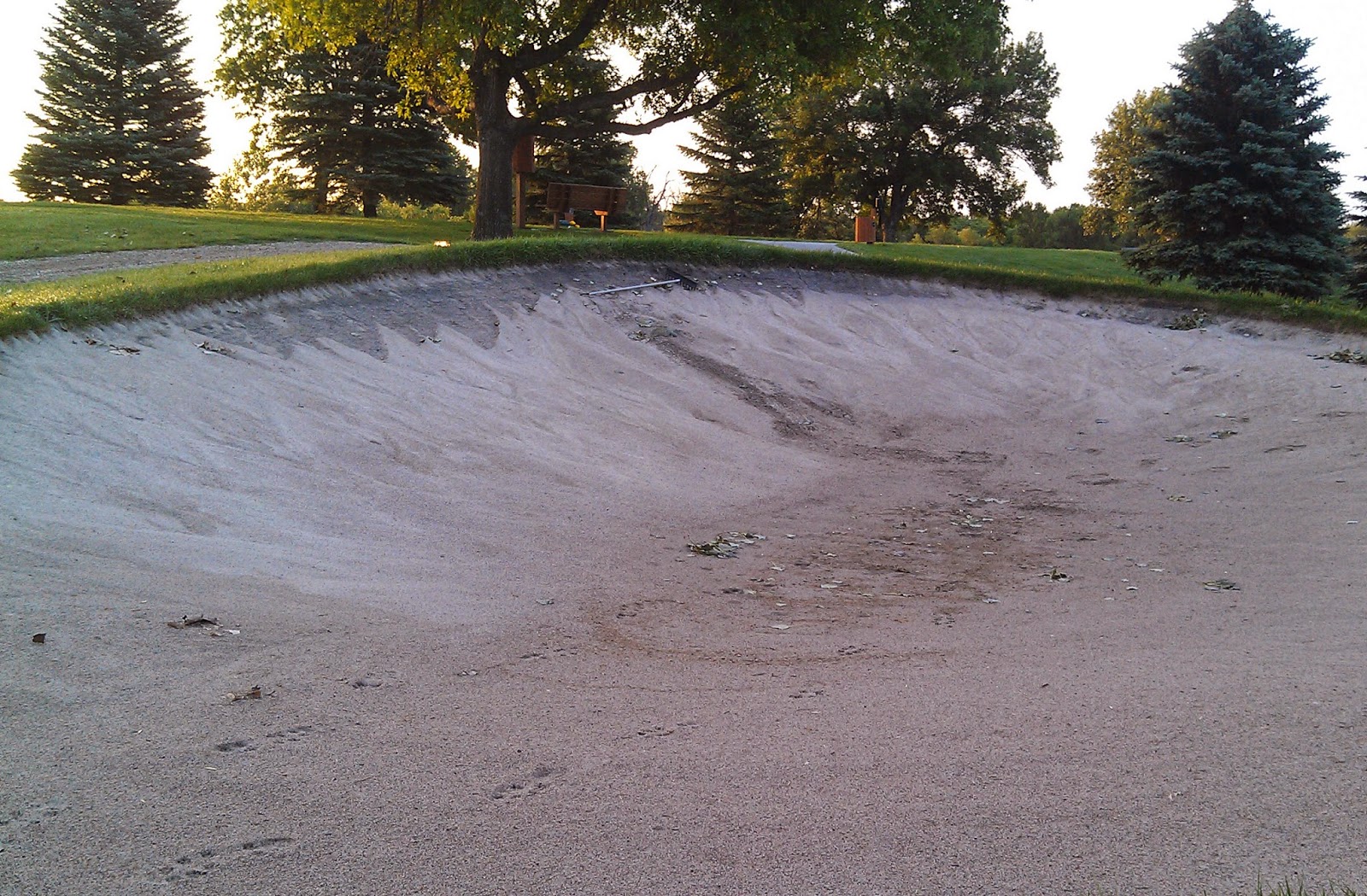
Also, with 2" of rain that fell in less than an hour, every bunker on the course was washed out, some much worse than others.  As of this point, 12 of our 48 bunkers have drainage in them, but that didn't stop how much the sand washed off the face, it just meant that we didn't have to pump them out.

Pushing the sand back up the face of the bunkers is a tedious task that requires a lot of precision.  It is very easy to dig too deep with the blade on the bunker rake and pull up chunks of clay, drainage rock, or drainage fabric, all of which are not very good scenarios, so it is a relatively slow process.  It will likely take us the rest of this week to finish pushing the sand back up the faces and repairing all of the bunkers.

The bunker by 15 green was one of the worst, but every bunker will still
need to have some sand pushed back up on the face.

July 19, 2014

Irrigation Upgrades

It seems like just a few weeks ago that I was begging for it to stop raining so the course could dry out some.  Now that the river has gone back in its banks and summer has started for real, we start to switch gears to putting water back on the course.

Utilizing our new pipe puller attachment that fits on the back of our compact tractor, we can now quickly and efficiently add irrigation lines whenever and wherever we need to.  Our first priority was pulling a line for a quick coupler (hose connection) up to the tee box on #2.  The sprinker coverage on that tee in particular is very poor, so it is necessary for us to have to handwater it from time to time.

Next, we added a line across 17 fairway into the left rough where we have frequent flooding problems.  That area has been seeded now 5 times in the 4 years I have been here, and it is always a struggle since there is no irrigation coverage down there.  While seed germinates and takes alright down there in the spring when there is plenty of rain, after a really late summer flood like we had this year, there is no way we would get anything to grow down there (besides weeds) without being able to irrigate it.

Our new 3-point pipe puller laid a new line across 17 fairway in less than 10
minutes, and with very minimal disruption.

In an area that floods at least once, if not twice annually, these 3 new
irrigation heads should be able to help us finally keep some decent
turf down on the left side of hole 17.

One of the downfalls of pulling pipe on an irrigation system that has been
added on to so many times.   Random wires snake through the rough
almost everywhere, these wires in the rough on 6 that power our irrigation
controllers were buried only 3 inches deep, and were 20' away from the mainline
(where they were supposed to be)

June 24, 2014

Topdressing and Interseeding

Monday was a busy day for the turf management team as we gave the greens on the course a healthy dose of love in the form of topdressing, spiking, brushing, and rolling.  This process helps to incorporate sand into the top organic layer of the turf profile to help dilute thatch and produce a firmer and smoother putting surface.

While doing so, we also made our first attempt at interseeding Alpha bentgrass into 6 green.  This green in particular has the highest percentage of Poa Annua of any green on the course (at least 90%) and because of this it has consistently been one of our poorest performing greens as well.

To complete the interseeding process, we started by scalping the entire green, collar, and approach down to a very low height to help open up the canopy in order to get seed in the ground.  The green was then spiked and seeded at a half rate.  The topdressing sand was then applied, another half rate of seed applied, and then the entire surface was spiked 3 more times to help work the seed down into the surface a little where it will be able to retain water better and produce more effective germination.  The green was then rolled and topdressed again.

Scalping down the green, collar, and approach on 6.
Collin dropping the second half rate of seed after topdressing.
After the second seeding, we spiked the entire surface 3 different directions
Last step, just add water.  Seed needs to stay constantly moist in order to
germinate, so we will be regularly running the sprinklers on 6 green for
the next week or so.
I have to admit, that this is going to be a bit of a trial process.  I have seeded dozens of new greens in my career, but have never gone through the process or "reseeding" a green that is already covered with grass.  I am optimistic that this process will be successful and help to provide some much better turf conditions on 6 green in the coming years.  If we can make this process work well, we will be attempting it on some of our other more heavily populated Poa Annua greens and collars in the coming months and years also.

June 22, 2014

Someone Stop The Rain

With still over a week to go in the month of June, we have already doubled our average rainfall for the month with just shy of 7" having fallen out at the golf course.  The last two weeks have made it painfully obvious that we really need to make an investment on some additional drainage on the flat, upper holes of the golf course.

All told in the last week we have spent close to 150 man hours pumping and squeegeeing water off of holes 6 and 11, and there are still some large puddles of water out in the rough, and the fairways are extremely soggy.  Hopefully the rain cycle we have been stuck in takes a break here soon, I would love to get to use our irrigation system at some point this summer....

The ditch on 11/12 was overflowing into 11 and 6 fairway by Thursday evening.
Hole 11 fairway on Friday morning after the rain.  Not one drop of this water
drains on its own, it all has to be removed with pumps.
Cleaning off 6 fairway on Friday afternoon.
The cartpath between 6 and 11 is an absolute muddy disaster after these
big rains, and is high on my priority list for adding gravel to later this summer.
The worst part about all of this, is that it isn't a new problem.  Now in my 4th summer at GFCC, I would wager that we have wasted close to $10,000 in labor costs pumping and squeegeeing water off of holes 6 and 11.  The only summer we didn't have to remove any water was in 2012, which was a very dry year.  

Unfortunately, the real issue is that those two holes drain nowhere, literally.  They are almost perfectly flat.  The addition of the ditch in front of 6 tee, and the sump box in the right rough on 6 up by the green back in the 90s has helped some, but was really just the beginning of the fix.  The only real solution would be to rebuild those two holes and reshape them with catch basins and proper drainage.  Since that isn't a feasible option for us, I will be looking into some options for adding a significant amount more drainage tile in them this fall.

June 17, 2014

Seedhead Suppression

If you are a regular reader of this blog, you have surely picked up on my hatred of Poa Annua by now.  It is a horrible weed that makes my life miserable, however, it comprises close to 80% of the turf on some areas of this golf course, so it is a "necessary evil".  One of the worst evils of this plant is its physiological desire to produce a huge flush of seeds in the spring.

In the past we have been using a growth regulator called Proxy as a seedhead suppressor on the greens.  While it has mostly worked it has come with a bit of a price, mostly in its effect of causing soft and puffy surface conditions on the putting greens.  In a desire to try something different this year, we did some trials with a different product called Embark.

Embark has been used as a seedhead suppressor for Poa Annua in the golf industry for a long time.  However, it has seen somewhat limited use due to its effect of causing some yellowing and bronzing of the turf it is applied to.  Proxy in general does not have this effect, but it also is not as effective as a seed inhibitor.

This spring we continued our application of Proxy to all of the greens and collars, however we treated hole 16 with Embark instead.  While the Embark did cause some minor yellowing in days 7-114 after application, the rebound effect afterward has been dramatic.  The areas we applied Embark are almost seedhead free, and the Poa Annua is a deeper and darker green that the untreated areas.

The turf where Embark was applied showed minor bleaching a few
days after the application.

The rebound effect has been dramatic however.  4 weeks after the
initial application, the Embark applied area looks much better
than the untreated turf.
We also sprayed a trial strip of Embark at the beginning of 6 and 11 fairways.  These two fairways in particular have the highest Poa Annua concentration of any of the fairways on the course.  The results were fairly dramatic here as well.  We observed the same issue at the beginning, where treated turf looked a little off color for the first week, but so far weeks 3 and 4 after application we have seen some great effects.
The trial strip on 11 fairway shows that the Embark treated turf is much
greener, denser, and healthier than the untreated Poa Annua.
The timing of any of these growth regulators is crucial in order to achieve maximum Poa Annua seedhead suppression.  It is even more difficult to time here in the North where we have such dramatic temperature fluctuations in the spring.  We will be doing a few more trials with this product on some other areas of the course throughout the summer, in the hopes that we will be prepared to use this product extensively first thing next spring.

May 27, 2014

Holes and Sand

We wrapped up another spring aeration of the greens today with absolutely perfect weather to help keep the process moving along smoothly.  I realize that millions of holes and thousands of pounds of sand on the greens is less than ideal for the golfers, but it is hard to deny the many important benefits of aeration.

There are really three reasons that aeration is so beneficial, especially on such highly maintained surfaces as a putting green.  Most importantly, aeration opens up the turf surface and allows the proper balance of water, nutrients, and oxygen to reach the roots.  Secondly, turfgrass roots love growing deep and fast into the loose channels of sand that we provide from aeration.  This root development will help to sustain the plants during the hot and stressful summer months.  Lastly, the aeration holes and fresh sand help to dilute the surface organic matter (thatch) that would otherwise leave the greens soft and puffy if left to accumulate unchecked.

Like all things that age, a putting green also requires some serious upkeep and maintenance.  No different than an aging car that went to the mechanic to get fluids flushed, belts changed, bearings replaced, etc.  You could drive that car potentially for awhile longer without doing those things, but the risk of having a serious breakdown becomes much greater.  The same goes for our turf.  Without routine aeration, the potential for a hot and humid summer would leave our greens prone to a major breakdown.

Punching holes with our new aerator we purchased last fall
After the sand has been applied, and the holes punched, then the
sand is drug in with a broom and the surface blown off.
We utilized a new tine configuration this spring as well that should help in a few areas.  The tines we used were smaller than usual, but on a much tighter spacing.  Overall we affected about 10% of the total surface area, which is about the same as when we use the larger size tines.  However, since these tines are much smaller, the tops of the holes will grow over significantly quicker.  Combined with daily rolling for the next few days, and the holes should be almost completely gone within a week.

May 21, 2014

Pond Leak....Again

It appears that my post back in the end of April about the pond overflow being fixed was a bit premature.  Something changed underground very abruptly last week when the remaining frost finally came out, and the hole in the bottom of the pond where the old overflow pipe was buried opened back up.

Last fall when we dug out the old riser on the pipe, the stub of the 15" steel culvert was dug back into the pond back, smashed, folded back over its self, and buried under 5,000 lbs of concrete and about 2' of silt.  Water however has an amazing way of sneaking through even the smallest of crevasses, and apparently managed to find a path under the concrete slab, and began to quickly erode a channel under it and find its way into the pipe.

The leak became so bad late last week that it was obvious we had no choice but to fix it.  The leak almost completely emptied the pond (about 1.5 million gallons) in only 3 days.  After the pond was empty, we rented an excavator this week, reburied the concrete block in silt, and then dug about an 8' deep hole in the cartpath on hole 8 to remove a section of the pipe and thoroughly fill and pack the void with clay.

Pond leakage at the end of April (just a trickle)


Pond leakage 2 weeks later

Digging the old pipe out in the middle of the cartpath on hole 8

We struggle enough to keep our irrigation pond full of water throughout the summer, allowing this leak to continue throughout the season would have made that an almost impossible task.  While the current fix should prevent any further leakage this summer, the real solution will be to go back in late this fall after the course is closed and dig out the entire 50' section of pipe and refill the entire void with clay.