August 5, 2015

What's Wrong With 6 Green?

That's a great question, and to be completely honest, I don't exactly know.  6 green has always been a struggle, I found out within my first month here in 2011 that 6 green didn't react or grow like any of the rest of the greens.

Last fall you may all remember that we did some extensive work to the green by heavily seeding it with bentgrass and very gently coaxing the bad areas on it back to health.  We also went along the left side of the green last fall with a trencher and cut all of the cottonwood roots that were growing up under the green and sucking all the water and nutrients out of it.

This spring 6 green was in great shape, almost amazingly good shape considering how bad some of the other greens looked.  At that point I was convinced that all the work we had done last fall had worked.  I started to notice however in May that a lot of the new bentgrass seedlings started to choke out and a lot more Poa annua was starting to come back in.  Then, by about the beginning of June the same areas on the green started declining again.

Everywhere on 6 green where we are seeing areas die are all Poa annua.  We starting cutting way back on the growth regulator on it, whereas the rest of the greens we kept on our growth regulator program that is helping us keep the Poa annua in check.  To be completely honest, I really don't know why the Poa annua in 6 green keeps dying, when it just turns a little yellow and sunken on the rest of the greens.

This is the area on the left side of the green that we roped off and heavily seeded last fall.  As you can see, there is
a lot of bentgrass in there, but all of the Poa areas die amazingly fast here for some reason.

This is an area on the front of the green where we put the last of the bentgrass sod from our nursery in last fall.  The Poa
annua surrounding this area is still alive, but definitely not doing too well.

Last fall I took soil samples from all of the bad areas on this green and had them tested for salinity, nutrient availability, and soil structure.  All tests came back just fine.

At this point, based on the fact that we are seeing all of the bentgrass not only survive, but thrive in this green, the only logical solution I can come up with is to just keep sodding out all of the dead or dying areas on the green with sod from our nursery when it becomes available next spring.  The rest of the summer and fall we will continue to baby the bad spots on the green with some extra water and fertilizer, and less frequent mowing and rolling, and see if we can get some decent recovery.

July 27, 2015

Turf Nursery 3.0

Tucked away in the far northwest corner of the property beside 13 tee is one of the most important areas on the golf course.  Over the last three years, we have been constantly expanding our turf nursery in that area where we grow all the extra grass used to repair damaged areas on the course.

We first created a very small nursery there in 2013, built it a little bit larger in 2014, and now in 2015 we have finished version 3.0 that features a whopping 6,000 sq ft of bentgrass (compared to about 3,500 sq ft last year.)

We prepped the area by stripping all of the bluegrass rough sod to use out on the course, we then added two more irrigation heads in the area where we wanted to expand to, hauled in about 30 tons of sand, and then started shaping.

The area is graded so that it is high in the middle, thus making it shed surface water off in all directions without puddling.  We applied a variety of starter fertilizers to the entire area to encourage seedling growth and development, and then seeded a mixture of T1 and Alpha bentgrass.  Our goal is to push the turf on the nursery to establish as dense as possible by the end of the year, with the idea that it can be harvested as sod first thing next spring.

Shooting grades on the sand in order to ensure that there would not be
puddling water in the area.

Collin dropping seed.  We are trying a blend of two different, but similar
bentgrasses, T1 and Alpha this year.

After about 5 days of very light, frequent watering, the seed begins to
germinate.  This picture was taken on day 10.

Today marked 19 days after seeding, and the area received its first
mowing.  Overall the seedlings are off to a great start.

After a winter like last year, and the spring that followed it, expanding our nursery is the greatest insurance policy we can have against mother nature.  The Poa annua in our greens and collars will continue to die more winters than not, and it has always been my goal to get as much bentgrass into those areas as possible in order to be able to provide more consistent turf conditions during all the months of the golf season.

July 17, 2015

Rolling Through Summer

It's hard to believe it's already the middle of July.  As usual, summer is flying by.  It always seems that it creeps up on me as we spend so much time and energy getting the course put back in shape after our long winter, its hard to believe that the days are already getting shorter.

We spend so much time in the spring doing all the "extra" things with all the sod work we did this year in the greens and collars, seeding in the fairways, finishing the clubhouse landscaping, fixing and getting the irrigation system dialed in, repairing and edging bunkers, and training staff on all of our equipment.  After we have finally completed all of those "extra" items, we can now focus on simply maintaining the turf on the golf course and ensuring the course is set up to be its best every day.

At this point in the summer, it finally feels like we are finding our rhythm out on the course.  The staff is doing a great job getting the course set up every day and getting all of the little extra things accomplished that most golfers probably never realize go into keeping the course looking great.  The course is finally looking and playing great, as long as the weather continues to cooperate, we are essentially on cruise control for the rest of the season.

Here's a couple of pictures from the crew out getting the course prepped during the last few weeks.

Mowing greens has been great this year with our new John Deere
220E walking mowers.

We also have a new wide area rough mower this year, meaning most
mornings we send out three rough units.

Collin has been crazy busy on the sprayer so far.  We dialed in our fairway spray
program this year to go out every two weeks on fairways, and thus far the results
have been great.

A new process we have been doing this year is dragging the dew off of
fairways in the mornings to help them dry quicker, which has led to
significantly less disease development.

One of other changes this year has been utilizing solid front rollers on our greens
mowers, which helps promote bentgrass growth.  Every other week we are
brooming greens before mowing in order to help cut off some old leaf tissue.

We have a few extra guys trained on changing cups this year, meaning usually
6-7 days a week we are moving cups.

The fairway mowers have their morning routine dialed in and have
the fairways looking better than ever.

As always, bunker maintenance takes up a significant amount of our time
on the course.  We try to keep them regularly edged, smoothed, raked, and
sand pushed up on the faces after all of the rainstorms.


June 25, 2015

Staff Appreciation Day

The GFCC was hosting an outside tournament today, so with the golf course packed with golfers, the grounds crew took the opportunity to take the afternoon off from work.  We all went out for lunch at the Blue Moose, followed by a friendly competition of scramble golf at the Valley Golf Course.  It was a great afternoon break from work at the course and fun to do some team building away from our own golf course.

If there is an under appreciated job in the golf business, it is that of the grounds maintenance worker.  Out early on the course seven days a week at 6:00am (sometimes as early as 5:00am during tournaments), our team lives by the mantra "out of sight, out of mind".  Our best work is done early in the mornings when the course is quiet and we can make a mess, get things fixed, complete necessary maintenance tasks, and get the course prepped for play.  This team performs tasks on a daily basis ranging from mowing any of our 100 acres of turf, rolling greens, sodding and seeding, raking bunkers, pulling weeds, digging holes, trimming around trees, changing cups, blowing grass, fertilizing and spraying, trimming tree branches, fixing irrigation leaks, picking up trash, disposing of dead animals, you name it.  

A huge thanks to Collin, Justin, Matt, Alyssa, Terrance, Logan, Max, Michael, James, Hunter, Jake, Jack, Connor, Andrew, and Mitch.  Without these hard working guys (and gal), there would be no golf course at the Grand Forks Country Club.


June 10, 2015

Sod Projects

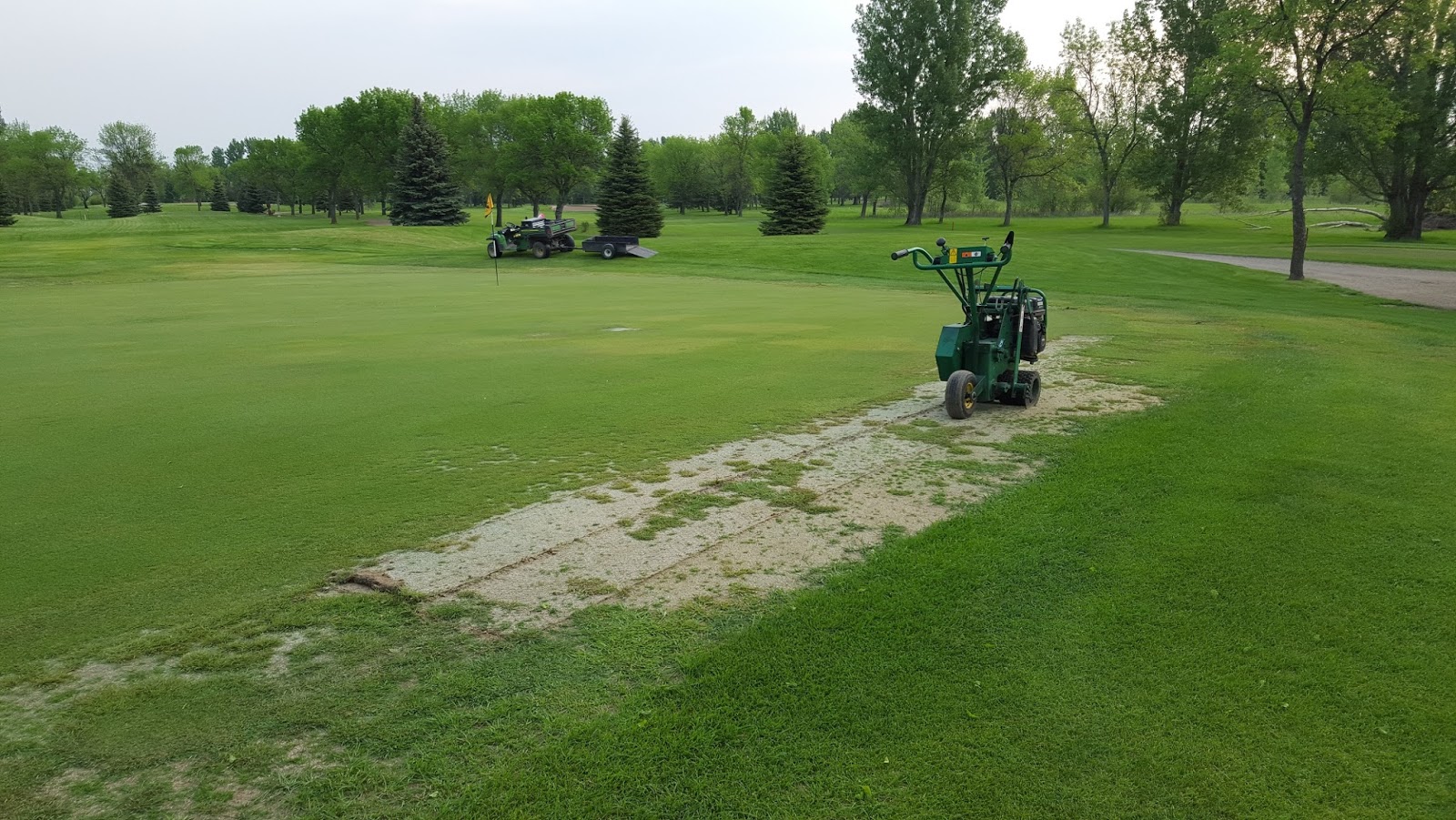
Our sodcutter has come out of hibernation with a vengeance this spring.   This 18 year old piece of equipment has been doing overtime since early May cutting dead Poa out of our greens, collars, and fairways, and harvesting healthy bentgrass to replace it with, from three different states.

At this point we have finished doing all of the sodding around our collars that we are going to do.  We started by cutting all 4,000 sq ft from our nursery by hole 13.  We then found a course in Minneapolis that wanted to get rid of their nursery, so we made a road trip down there one day with a trailer and hauled back another 1,500 sq ft of bentgrass.  Lastly, we ended up buying one pallet of sod from a farm in Wisconsin.

One of many areas of dead Poa that we cut out of our collars

We cut, loaded, and hauled a full truck and trailer of sod from a nursery
at a golf course in Minneapolis

Putting in new bentgrass sod in the collar on 5

Sodding on 10 collar

Our nursery is officially gone at this point.  We hope to get it cleaned up,
enlarged, and reseeded by the end of June so that it can be grown in and
ready to start cutting again next spring.

We have now moved on to cutting some fairway length bluegrass from our nursery area to start sodding out some of the dead Poa in the fairways.  We are starting in the really bad spots in 11 fairway, and in some of the fairway perimeters by the greens.

All of the dead spots in 6 and 11 fairways were caused by low areas that puddled
water during the mid-winter melts, forming ice.  While we are cutting out and
replacing the sod, we have also been adding sand and leveling the low spots.

The last step in the recovery process has been to cut smaller, cup cutter size plugs out of the back of the practice hole green to fill in all of the smaller dead areas in the greens and collars out on the course.

I was hoping we wouldn't have to, but we are sacrificing the back corner of
the practice hole green again this year.  The crew has already taken hundreds
of plugs out, with many more still to come.
Most importantly, I want to throw out a huge thanks to our staff who have put in an amazing amount of work doing all of the sodding and plugging work.  While we have so far sodded out about 6,000 sq ft of dead grass, that means all told they have hauled about 18,000 sq ft of sod by cutting and removing the dead grass, cutting and loading the new turf, and then unloading and laying it in place.  If my math is right (which it sometimes is) a roll of sod is about 4 sq ft, and weighs 30 lbs.  That means our crew has handled 135,000 pounds of grass this spring.

May 25, 2015

Greens Update


Here we are nearing the end of May, and still dealing with the consequences of unfortunate weather events that happened back in December and January, almost half the year ago.  It has been no secret that all of the Poa annua in our greens and collars did not make it through the winter, the amazingly odd part has been that very little of the Poa in the greens has decided to recover much yet either.  While the collars are very slowly filling back in, I estimate that only about 10-20 percent of the Poa that died in the greens is making a return to life.

This situation presents a bit of a double-edged sword for us.  The greens are in much less than desirable condition right now with the voids from all the dead Poa leaving the putting surfaces about as smooth as a gravel parking lot.  Conversely, if the Poa decides it doesn't want to come back, great.  We are doing all that we can so far this spring to push the bentgrass into filling in the voids where the Poa died.  The more bentgrass is in our greens and collars, the less we will have to deal with scenarios like this in the future.

There is hardly a single living blade of Poa annua is this picture.  Normally by
now all of those dead voids would be filled with Poa bursting to life.  For whatever
reason, that has not happened this year.

So far this spring we have been doing all that we can to keep the bentgrass spreading out into the dead voids.  A little bit of extra topdressing sand has helped level out the depressions making the greens putt a little smoother, and giving the bentgrass something to spread into.  Furthermore we have been filling some of the larger voids with bentgrass plugs from our practice green, utilizing smooth rollers on our cutting units, doing a bit of spot seeding here and there, and regularly rolling.  Combined with a little bit of extra fertilizer and the areas are slowly starting to fill in.  However, it is a long road back back in some areas still.


18 green received some serious attention last week with the collar getting
sodded out, about 100 bentgrass plugs in the larger Poa voids, and spiked, seeded,
and topdressed in the smaller damage areas.

Lots of plugs in the front of 11 green
Getting started cutting plugs out of the practice hole green.  We will likely take
another 1,000 more before its all said and done.

Lastly, 16 green is showing some serious recovery after having been seeded and covered for the last few weeks.  All of our bentgrass seed germinated (although amazingly, almost no Poa seeds did.)  We will likely open hole 16 back up in the next few days as the new bentgrass seedlings start to mature and take hold.  It will likely putt a bit slower than the rest of the greens for a few weeks as we continue to go easy on it to allow for complete recovery.

Lots of bentgrass seedlings are filling in the bare areas in 16 green.  It should
make an almost complete recovery here in the next few weeks.
Needless to say, this has been a very trying spring so far.  It is extremely frustrating to deal with damage to the golf course that is the result of weather events that happened months ago.  However, we are making the most of a bad situation by quickly converting our greens to a mostly pure stands of bentgrass.  The more Poa annua we can keep from coming back this year, the more consistent our greens will be in the summer months, and the less devastating loss of turf we will have to deal with in coming winters.

May 13, 2015

Course Markings and Native Areas

The greens committee toured the course a few weeks ago to discuss some of the markings on the course and to look at moving around some of our native grass areas that we have added over the years.

One of the major changes we decided to enact was to remark what had previously been Out of Bounds in the prairie area between holes 2, 3, 4, and 6 into a lateral hazard.  There was really no reason for the area to be marked Out of Bounds as the area is all property of the GFCC.  Remarking this area as a hazard will allow players to look for and play their ball out of that area, or drop a ball along the hazard, as opposed to having to take a stroke and distance penalty.

Furthermore, we made some tweaks to our native grass areas.  We mowed out some areas on the left side of 2, the right side of 9 along the creek, and the right side of 17 behind 16 tee.  These areas are where a lot of only slightly errant tee shots were getting lost in the tall grass.

We also reclaimed some areas that Cole Creek and constant flooding have turned back into weed infested wastelands.  These areas are along the right side of 9, right side of 15, and the right and left side of 17 on the green side of the creek.

Previous native area left of hole 2 mowed back down to rough height.

After cleaning up a bunch of weeds, overgrown trees, and some piles of old
flood silt, we were able to reclaim 15' - 20' of rough on the left side of 17.

Previous native area on the right side of 9 mowed back to rough height.
We reclaimed a lot of area on the right side of hole 15 where years and years of
silt removal had created massive piles of dirt and weeds.  The area was leveled,
weeds sprayed, and will be reseeded next week.

There were also some areas on the course where we moved our native areas out into the course a little further as well.  Most of these areas are along or behind tee boxes, or in areas so far away from the line of play of the hole that very few balls will end up there.  That isn't to say that a few extremely errant shots won't find their way into some, but it should be few and far between.

The reason for letting these rough areas grow back into native areas is two-fold.  Most importantly, it comes down to dollars and cents.  Our rough mowers are extremely expensive machines with a lot of years and hours on them, diesel fuel is expensive, and so are operators.  Every bit of rough that we can quit mowing is money back in our bank account, and more time our staff can spend working on other areas of the course.  Secondly, letting these areas grow back to prairie gives the course a more natural look and adds a lot of extra texture to the property.

This area right of 2 tee is getting let go back to native.  If you miss the fairway
on hole 6 by more than 100' you could lose your ball here.