I'm sure we can find a way to squeeze a few of these into our budget...

An in depth look at the maintenance practices and special projects at the Grand Forks Country Club
February 16, 2012


Are the greens still alive?
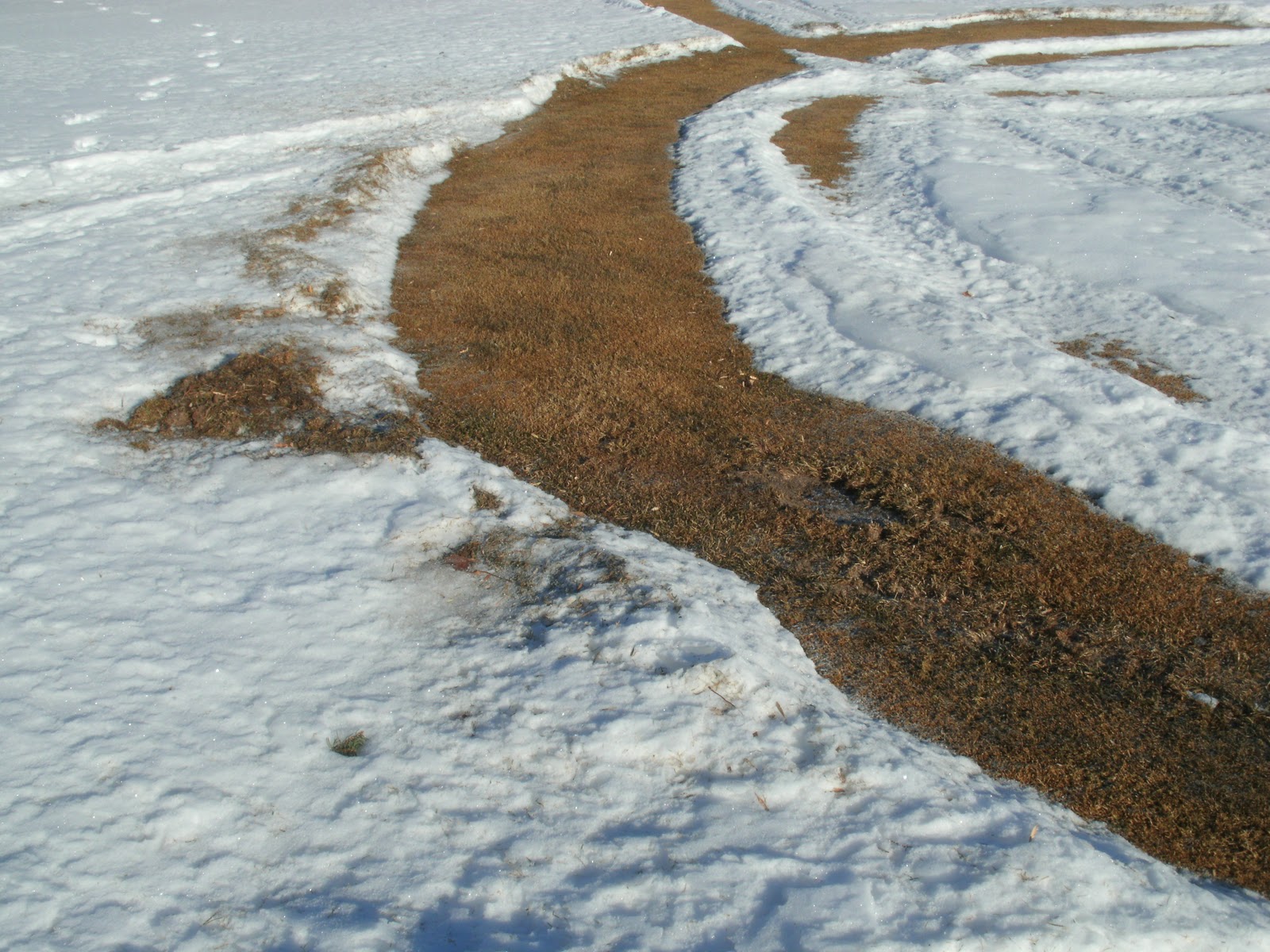
Sounds like an odd question, and the answer is a 97% "definitely"! However, one thing that has me concerned is the ice layer that formed on some areas after our little bout with the snowmobile traffic back in the beginning on January. The ice that formed on some areas of the greens that received significant traffic has set up into a variety of different layers. Some ice is not very thick, and is still kind of porous and faceted, allowing oxygen exchange between the turf and atmosphere. Some of the ice however has set up a little thicker and denser in some spots, and those are the areas that concern me.
4 green for example took a heavy load of sled traffic across the left side, and a few isolated spots have set up into 1/4" to 1/2" of dense ice. I went out this week, chipped off the ice in one of the worst spots, and took a 1 1/2" core sample of the green with a hole saw bit in a drill. The plug thawed out inside overnight, and is now planted in a container of sand, watered, and sitting in the windowsill of a south facing window in my 70 degree office. It definitely should not take too long to find out if this turf is alive or not.
My guess is that the turf is just fine. However, if that plug doesn't start to green up in a week or so there is a pretty good chance you'll be seeing a follow up blog post with pictures of Andy and I out on some of the greens with a snowblower, ice picks, and shovels....

4 green for example took a heavy load of sled traffic across the left side, and a few isolated spots have set up into 1/4" to 1/2" of dense ice. I went out this week, chipped off the ice in one of the worst spots, and took a 1 1/2" core sample of the green with a hole saw bit in a drill. The plug thawed out inside overnight, and is now planted in a container of sand, watered, and sitting in the windowsill of a south facing window in my 70 degree office. It definitely should not take too long to find out if this turf is alive or not.
My guess is that the turf is just fine. However, if that plug doesn't start to green up in a week or so there is a pretty good chance you'll be seeing a follow up blog post with pictures of Andy and I out on some of the greens with a snowblower, ice picks, and shovels....

February 13, 2012
Audubon Cooperative Sanctuary Program
There are without a doubt a lot of myths in today's society about the negative impacts that golf courses have on the environment. Almost all of them are untrue. In a world that focuses more and more on the "green" aspect of almost everything, there are a number of golf organizations that are working together to get our business segment on board.
Audubon International has put together a program with the help of the USGA called the Audubon Cooperative Sanctuary Program (ACSP). Golf courses that choose to participate start by filling out an environmental self assessment. The ACSP then makes certain recommendations the course must enact in order to attain certification as an Audubon Certified Sanctuary. Areas of evaluation include: environmental planning, wildlife management, chemical use reduction and safety, water use reduction, water quality management, and community outreach.
While creating an environmentally and ecologically sound golf course is the right thing to do, it is only a realistic goal if it makes business sense as well. Fortunately, a lot of the initiatives that the ACSP recommends are things that we are already implementing here at GFCC. As one may (or may not) expect, a lot of environmental initiatives also tend to go hand in hand with the efficient operation of a golf course. It kind of has the tendency to be "less is more". All the tangibles that tend to go into the operation of a golf course (fuel, fertilizer, water, pesticides) all cost money to utilize. The ACSP seeks to find the balance of using only the amount of those that are necessary to obtain the desired level of aesthetics and playability of the golf course, and not an ounce more.
A perfect example of this was the amount of fertilizer applied we applied to the golf course this year. Compared to 2008, 2009, and 2010, we used approximately 40-50 percent less fertilizer in 2011. Did anyone notice that the course wasn't very green or that the turf was unhealthy this past summer compared to years past? I wasn't here in past years to make the comparison, but my guess is that probably no one noticed a difference. That amount of fertilizer saved us approximately $7,000 this year, and also saved a countless amount of nitrogen and phophorus from going into the Red River. And guess what? Fuel usage dropped as well (less fertilizer, less top growth, less mowing!) And to go along with that, less mowing means....less labor used to run the mowers!

The above example is only a small portion of the types of things we can do to not only improve our environmental performance, but to improve the bottom line. I made the decision to enter the GFCC into the ACSP program this winter for the simple fact that since we are on the path toward doing all the right things environmentally anyway, we might as well gain a little recognition for it. There will certainly be a fair amount of work to go into gaining certification, but most of that will simply involve a lot of recordkeeping and documentation and will involve no real output of financial resources. I really feel that in the long run, involvement in this program will continue to help the course become a more efficient operation.
The Audubon Cooperative Sanctuary Program has certified over 2,000 golf courses across 24 different countries around the world. The neat part about this, is that there isn't ONE single course certified in the state of North Dakota. We could literally claim to be the first! Everyone involved with the GFCC knows that without a doubt we lay claim to a very rare oasis in the vast agricultural plains of the greater Red River valley. Let's do our part to take care of it and let everyone else know in our community how special the place really is.
Also, I've attached a neat video about all the wonderful things turfgrass does in our world.
February 9, 2012
New stuff
A few new things for everyone to look for this spring once golf season gets underway:
First off, the old red/white/blue 150 yard stakes indicating pin placement depth on the greens will go away. All the stakes will be left white, solely as a yardage marker. The golf carts will be fitted with a new information sheet holder on the inside of the roof of the cart that will hold our new pin placement sheet. I went out last fall and drew a detailed sketch of each green, and then located six general zones where we tend to place our pins. Some greens end up with lots of front placements, some greens have a lot of middle placements, but most don't have a lot of back placements due to the severe slopes on the backs of the greens.


First off, the old red/white/blue 150 yard stakes indicating pin placement depth on the greens will go away. All the stakes will be left white, solely as a yardage marker. The golf carts will be fitted with a new information sheet holder on the inside of the roof of the cart that will hold our new pin placement sheet. I went out last fall and drew a detailed sketch of each green, and then located six general zones where we tend to place our pins. Some greens end up with lots of front placements, some greens have a lot of middle placements, but most don't have a lot of back placements due to the severe slopes on the backs of the greens.

Pin placements will be chosen at random throughout the week, by either myself or Andy, who are really the only ones who ever cut new cups during the golfing season. The nice thing about this pin sheet is that I designed it myself in photoshop, so if we ever decide to rearrange the pin placements I can just pull up all my files and a get new pin sheet put together in an hour or so. I would assume that at least annually we will re do the placement sheet just to mix things up some.
Along with this, I decided it would be good also to display some sort of sign around the 1/10 tee area to notify golfers which pin location they will be playing that day. As some of you may have noticed, the old green wooden holder that the extra sand bottles get stored in by the cartpath at 1 and 10 tee is in rough shape. I figured it made sense to combine a new sand bottle holder with a sign for the pin locations. So last week I spent a few days working at home in my wood shop in the garage and put this thing together....

Combined with the structure are two different compartments, one side with extra scorecards and pencils, the other side with extra pin sheets and divot tools. In the middle is the pin location sign with a round cutout in the middle, I made a total of 6 wooden discs numbered from 1-6 that Andy or I will place in the sign holder when we go out to cut the related pin placement that day.
This will be mounted on a wooden post in the triangle between where the cartpath splits from 1 to 10 tee, but will likely be placed back a little further from the cartpath as the current sand bottle holder is. I am thinking right now, that we will probably place some paving stones in the carthpath delta there to make a walking path to the get to the sign (and also so we don't have to mow any grass around it) and hopefully will find a way to work in a flower garden bed somewhere also to add some color to the area.
Should make for a fun project in the spring and hopefully spruce up the area at the start of the golf course!
January 28, 2012
What goes up.....must come down
There is a very fine line between too much and not enough snow cover on turfgrass during the winter. Not enough snow and the turf becomes exposed and dessicates all winter in the sun and wind. Too much snow and it takes too long to melt in the spring, sets up into ice, and increases the snow mold pressure. Just the right amount of snow protects the turf during the winter, but dissappears quick enough in the spring....without too much extra manual labor.
We finally have had enough snow and wind, now that it is nearing the end of January, to remove the snow fence that was put up back in November. Most of the high backs of the greens that are most exposed to the wind have collected anywhere from about 8"-15" of snow on them. Most importantly, that snow has experienced a variety of wind relocation and thermal melting from the sun to set it up into a nice, firm composition. That snow now has no chance of blowing away at this point in the winter. Andy and I spent a few hours out of the course one nice afternoon this last week and pulled the fences off of those greens to keep any additional snow from accumulating. The only greens that haven't quite accumulated enough snow yet are 9 and 18 for whatever reason, so those fences will remain up for awhile.
We finally have had enough snow and wind, now that it is nearing the end of January, to remove the snow fence that was put up back in November. Most of the high backs of the greens that are most exposed to the wind have collected anywhere from about 8"-15" of snow on them. Most importantly, that snow has experienced a variety of wind relocation and thermal melting from the sun to set it up into a nice, firm composition. That snow now has no chance of blowing away at this point in the winter. Andy and I spent a few hours out of the course one nice afternoon this last week and pulled the fences off of those greens to keep any additional snow from accumulating. The only greens that haven't quite accumulated enough snow yet are 9 and 18 for whatever reason, so those fences will remain up for awhile.
 |
| 13 green |
 |
| 4 green |
 |
| 12 green |
January 10, 2012
Snowmobile Damage
For those or you who may have seen me recently and asked how winter was going on the golf course, you probably noticed the steam coming out of my ears as I mention the insane amount of snowmobile traffic we experienced on the course after our first good snow about 2 weeks ago. I was warned by more than a couple individuals that there was some snowmobiling that took place out here, unfortunately for whatever reason I must have underestimated the fact that apparently every snowmobiler in Grand Forks thinks that the country club is their private snowmobile course.
All the greens are now fenced off, and the three main access points the snowmobilers seems to use to get onto the course have been roped off with a nice warning sign. The Sheriff was notified of the significant trespassing/property damage. My next option is to start burying rebar stakes in the bunker face "jumps" to see if I can start wrecking the sleds of those trespassers. Or, as Derrick mentioned recently, I may have to put up a deer stand and start sniping off the violators with a paintball gun or something. Regardless, I have never in my life seen such blatant disrespect for private property. Consider this WAR.
I have to halfway blame myself for some of this because I can't say that I wasn't warned, I just totally underestimated how much snowmobile traffic really came out to the course. Regardless, protective measures have been taken, whether or not they will make a difference has yet to be determined.
At least we finally got some snow cover on the turf, but I guess with one blessing always comes another challenge...
All the greens are now fenced off, and the three main access points the snowmobilers seems to use to get onto the course have been roped off with a nice warning sign. The Sheriff was notified of the significant trespassing/property damage. My next option is to start burying rebar stakes in the bunker face "jumps" to see if I can start wrecking the sleds of those trespassers. Or, as Derrick mentioned recently, I may have to put up a deer stand and start sniping off the violators with a paintball gun or something. Regardless, I have never in my life seen such blatant disrespect for private property. Consider this WAR.
 |
| One of three new warning signs with a rope fence at the "entrance" points of the course |
 |
| Bunker ramps, have a feeling we will be repairing some smashed bunker lips in the spring |
 |
| Someone decided 6 fairway would be a good spot for some donuts, unfortunately with only 5 inches of snow the track still found the turf |
 |
| Here is the worst damage, all the snow that was packed down under the track sets up into ice on the greens. You can distinctly see loose, unpacked snow on the left, and ice formed under a snowmobile track on the right. Ice layers do not allow the turf to breathe during the winter and will literally suffocate the grass underneath of it. Poa is especially susceptible. There may literally be streaks of dead grass on the greens in the spring where the Poa will die under the ice from the snowmobile tracks if it doesn't melt off this winter. The other option is that Andy and I will have to go out in another month or so if it doesn't melt off and physically remove all of the ice with shovels. |
At least we finally got some snow cover on the turf, but I guess with one blessing always comes another challenge...
December 14, 2011
Cleaning house and.....Dought?
Life has finally slowed down a little for myself and Andy after an incredibly busy fall that blessed us with very dry, mild weather that allowed us to complete a lot of projects out on the golf course. Now that our outside work has wrapped up we are starting to turn our attention to the tasks we need to complete in the shop this winter. Those include servicing all the equipment and sharpening reels, doing some custom fabrication to create some new/improvements to some other equipment, building tee markers, building some new signage for the course, and doing a number of paperwork/book keeping endeavors to make sure we have all our ducks in a row before next summer starts. Before we were going to start any of this however, we had to clean the place up, big time.
I've seen some cluttered shops and work spaces in my day, but the shop here at GFCC had to take the cake as one of the worst. Since I have been here in the last 7 months, I continue to be amazed almost daily at the absolute amount of old JUNK I have come across and thrown away. To list a few of the best: An unopened box of equipment parts (for a piece of equipment that we don't even have any more) that was marked as shipped in 1997. I threw away an old hanging file folder full of the old superintendent's cell phone records that date back to 1996. In the pesticide storage building we were holding onto a box of fungicide that had a lot release date of March of 1995! Items like these were just the tip of the iceberg of the old junk that was taking up space in the shop and making it that much harder to find anything that may actually of been of any value, which I should mention we did find some of those things also. I think in the last 4 months I have hauled close to 6,000 lbs of scrap and junk iron to the steel recycler. At least we got a little money for some of that old stuff....
I have also been doing my best extreme makeover impression on the office in the shop, which was still decorated with 1982 wallpaper and carpet, and had been heavily smoked in over the years. I gutted the entire thing, scrubbed the walls, and then used the extra cash I had from recycling all the old steel to buy some new paint, carpet, and fixtures to help bring the place into the 21st century. The shop and office is now CLEAN, ORGANIZED, and FUNCTIONAL....a task I have really been wanting to tackle since the first day I stepped foot on GFCC property back in April, just haven't had time to do until now.
On a more interesting note, some of you may have caught some other posts about our current stretch of dry and mild weather this fall. The US Drought Monitor lists the entire Red River Valley as "abnormally dry" on the edge of going into "moderate drought". My weather records for rainfall and temps at the shop combined with some NOAA records show September was 2.4 degrees warmer than average with only 1.15" of precip compared to a normal of 2.05". October was a whopping 7.0 degrees warmer than normal with only .27" of precipitation compared to an average of 1.97". November came in at 5.4 degrees warmer than average with only .15" of precipitation compared to an average of .95". November also saw only 1.2" of snow compared to an average of 7.7" for the month.
All told, the months of Sep, Oct, and Nov. have come in 4.9 degrees warmer than normal and deficient close to 3.5" on precipitation. We also tied or broke a total of eight record high temperatures in those three months as well.
I don't think anyone is complaining about the lack of moisture as it seems to have drastically improved our flood outlook going into next spring, although there is still an awful lot of winter left. What the dry conditions have done however is left the turfgrass, in particular the greens, in a bit of a critical condition going into winter. Although the turfgrass plant is completely dormant at this point, it does still remain alive for the next few months. Just like a hibernating bear, the grass is asleep; but still needs to breathe, hydrate, and use it's energy reserves to stay alive until next spring. The ground is so dry, and the now the lack of snowcover leaves the turf plant susceptible to the brutal, drying effects of the winter wind. Even a small amount of snow cover would make a world of difference for the health of the greens right now.
Needless to say, I am a little concerned on a variety of fronts about the health of some of our greens come next spring. I will also be curious to see the size of some of the cracks that will show up as the frost continues to penetrate deeper into the dry, exposed ground. Let's just hope for a little bit of snowcover soon, followed by a nice, early spring.
I've seen some cluttered shops and work spaces in my day, but the shop here at GFCC had to take the cake as one of the worst. Since I have been here in the last 7 months, I continue to be amazed almost daily at the absolute amount of old JUNK I have come across and thrown away. To list a few of the best: An unopened box of equipment parts (for a piece of equipment that we don't even have any more) that was marked as shipped in 1997. I threw away an old hanging file folder full of the old superintendent's cell phone records that date back to 1996. In the pesticide storage building we were holding onto a box of fungicide that had a lot release date of March of 1995! Items like these were just the tip of the iceberg of the old junk that was taking up space in the shop and making it that much harder to find anything that may actually of been of any value, which I should mention we did find some of those things also. I think in the last 4 months I have hauled close to 6,000 lbs of scrap and junk iron to the steel recycler. At least we got a little money for some of that old stuff....
 |
| An engine that blew up 10 years ago was still collecting dust in the back of the shop. |
I have also been doing my best extreme makeover impression on the office in the shop, which was still decorated with 1982 wallpaper and carpet, and had been heavily smoked in over the years. I gutted the entire thing, scrubbed the walls, and then used the extra cash I had from recycling all the old steel to buy some new paint, carpet, and fixtures to help bring the place into the 21st century. The shop and office is now CLEAN, ORGANIZED, and FUNCTIONAL....a task I have really been wanting to tackle since the first day I stepped foot on GFCC property back in April, just haven't had time to do until now.
On a more interesting note, some of you may have caught some other posts about our current stretch of dry and mild weather this fall. The US Drought Monitor lists the entire Red River Valley as "abnormally dry" on the edge of going into "moderate drought". My weather records for rainfall and temps at the shop combined with some NOAA records show September was 2.4 degrees warmer than average with only 1.15" of precip compared to a normal of 2.05". October was a whopping 7.0 degrees warmer than normal with only .27" of precipitation compared to an average of 1.97". November came in at 5.4 degrees warmer than average with only .15" of precipitation compared to an average of .95". November also saw only 1.2" of snow compared to an average of 7.7" for the month.
All told, the months of Sep, Oct, and Nov. have come in 4.9 degrees warmer than normal and deficient close to 3.5" on precipitation. We also tied or broke a total of eight record high temperatures in those three months as well.
I don't think anyone is complaining about the lack of moisture as it seems to have drastically improved our flood outlook going into next spring, although there is still an awful lot of winter left. What the dry conditions have done however is left the turfgrass, in particular the greens, in a bit of a critical condition going into winter. Although the turfgrass plant is completely dormant at this point, it does still remain alive for the next few months. Just like a hibernating bear, the grass is asleep; but still needs to breathe, hydrate, and use it's energy reserves to stay alive until next spring. The ground is so dry, and the now the lack of snowcover leaves the turf plant susceptible to the brutal, drying effects of the winter wind. Even a small amount of snow cover would make a world of difference for the health of the greens right now.
Needless to say, I am a little concerned on a variety of fronts about the health of some of our greens come next spring. I will also be curious to see the size of some of the cracks that will show up as the frost continues to penetrate deeper into the dry, exposed ground. Let's just hope for a little bit of snowcover soon, followed by a nice, early spring.
Subscribe to:
Posts (Atom)